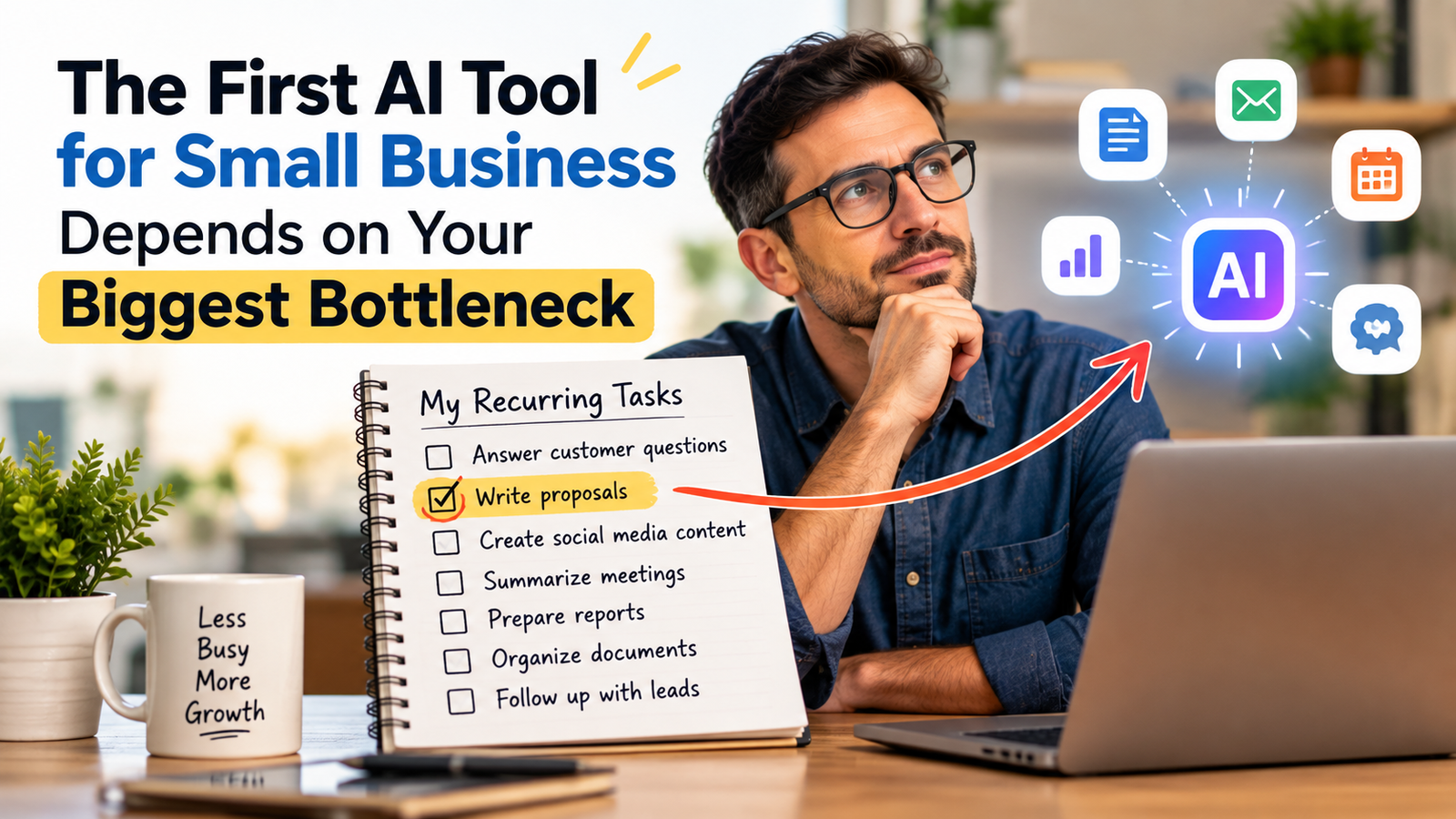
The First AI Tool for Small Business Depends on Your Biggest Bottleneck
The first AI tool you buy should not be the same as everyone else’s.
There is no single “best” AI tool for every small business.
If you run a small business, you may already know that AI can help with writing, customer service, sales, research, administration, and automation.
But that creates a different problem:
Where should you actually begin?
The answer is simpler than most AI tool lists make it sound.
Start with your biggest bottleneck.
Instead of asking, “What is the best AI tool for small business?” ask:
“What repetitive problem is costing my business the most time right now?”
That question can lead you to the right first AI use case.
Why your first AI tool should solve a bottleneck
It is easy to get distracted by popular AI tools.
You see another recommendation for a chatbot, writing assistant, automation platform, or AI meeting tool.
It looks useful.
So you sign up.
Then you spend time learning it, experimenting with it, and trying to figure out where it fits into your business.
That is backwards.
Your business should determine the tool—not the other way around.
The strongest starting point is usually a task that is:
Frequent: You do it regularly.
Painful: It consumes time or attention.
Low-risk: An imperfect AI output can be reviewed or corrected.
Measurable: You can see whether it actually saves time or improves the process.
This gives you a practical filter for choosing your first AI tool.
Find the task that keeps showing up
Think about the last seven days of running your business.
What did you repeatedly do that made you think:
“I shouldn’t still be doing this manually.”
Maybe it was:
Writing similar customer emails
Turning notes into proposals
Summarizing meetings
Creating first drafts of marketing content
Organizing information from documents
Answering recurring customer questions
Preparing routine reports
These are potential AI use cases.
But you don’t need to automate all of them.
Pick one.
Example: Your first AI tool might be a writing assistant
Suppose you’re a consultant who spends five hours every week turning meeting notes and rough ideas into client proposals.
You already understand your service.
You know what information belongs in a proposal.
And you can review the final document before sending it.
That makes proposal drafting a relatively straightforward place to test AI.
The goal isn’t to have AI replace your judgment.
The goal is to remove repetitive work from a process you already understand.
Another business may need something completely different
Now imagine you run a local service business.
Your biggest time drain isn’t proposals.
It’s answering the same customer questions every day:
What are your opening hours?
How much does this service cost?
How long does it take?
Do you serve my area?
How do I book?
Your first AI opportunity may therefore involve customer communication, not content creation.
Same technology.
Different bottleneck.
That’s why copying another business owner’s AI stack isn’t necessarily useful.
Don’t automate a broken process
There is one important warning.
AI can make a bad process faster without making it better.
If nobody knows what the correct customer response should look like, automating customer responses may create more problems.
If your sales process is inconsistent, generating more proposals won’t necessarily fix it.
Before using AI, understand the task.
Ask:
What does a good result look like?
If you can answer that clearly, you have a much better foundation for an AI experiment.
How to choose your first AI tool
Use this simple process.
1. List your repetitive tasks
Write down everything you or your team did repeatedly this week.
Don’t think about AI yet.
Just identify the work.
2. Find the most painful task
Which task takes the most time, creates the most frustration, or repeatedly interrupts more valuable work?
Start there.
3. Check the risk
Your first AI experiment should ideally involve work that can be reviewed before it reaches a customer, employee, or important business decision.
4. Define success
Decide what you want the tool to improve.
For example:
“I currently spend three hours a week drafting proposals. I’d like to reduce the drafting time to one hour while maintaining the same quality.”
Now you have something you can measure.
5. Test before expanding
Don’t build your entire workflow around a new AI tool immediately.
Test it on a small number of real tasks.
If it works, expand.
If it doesn’t, learn from the experiment and try a different bottleneck.
The best first AI tool for small business isn’t universal
The AI landscape will keep changing.
New tools will appear.
Existing tools will become more capable.
But the underlying decision remains useful:
Start with the work that is repeatedly slowing your business down.
Don’t buy AI because everyone else is talking about it.
Don’t automate something simply because you can.
Find the frequent, painful, low-risk task first.
Then find the technology that can help.
That is a much more practical way for a small business to get started with AI.
Frequently Asked Questions
What is the best first AI tool for a small business?
There isn’t one tool that is right for every small business. The best starting point depends on your biggest operational bottleneck, such as repetitive writing, customer questions, meeting summaries, research, or routine administration.
How should a small business choose an AI tool?
Start with the task rather than the software. Look for work that happens frequently, causes frustration, has relatively low risk, and can be measured. Then evaluate AI tools that address that specific task.
Should small businesses automate everything with AI?
No. Start with one well-understood, repetitive process. Test the results and keep human review where mistakes could affect customers, finances, or important decisions.
Is AI worth it for a small business?
AI can be useful when it reduces meaningful repetitive work or improves an existing process. The value depends on the specific task, implementation, and results—not simply on adopting AI.
Final takeaway
You don’t need an AI strategy with twenty different tools.
You need a good place to start.
Find the task you keep doing, keep delaying, or keep wishing someone else would handle.
That may be your first AI opportunity.
What is the most repetitive task in your business right now? Start there.