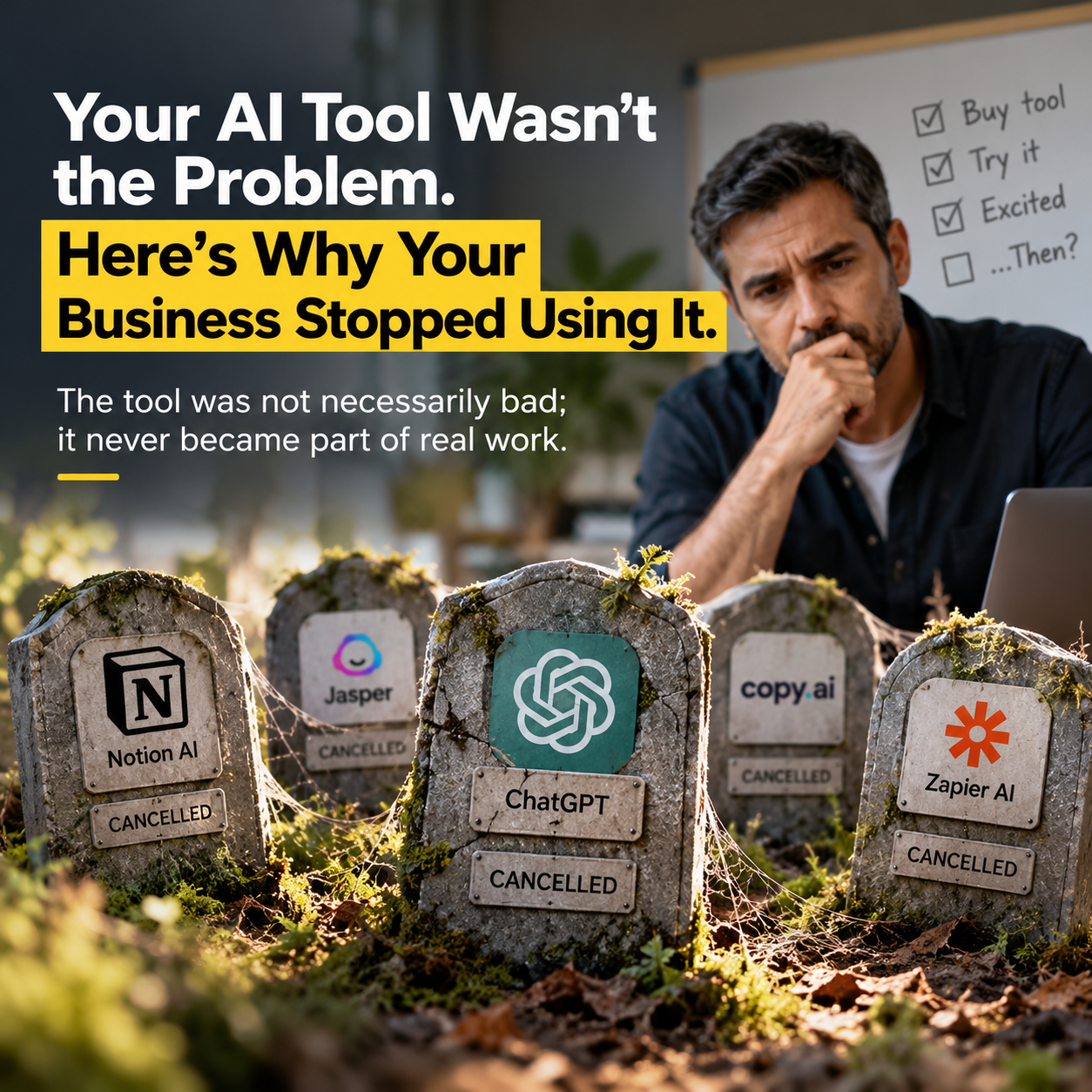
The tool was not necessarily bad; it never became part of real work.
Many small businesses are investing in AI tools with high expectations. They want to save time, reduce repetitive tasks, improve customer service, and make their teams more productive.
The beginning usually looks promising.
The business owner watches a product demonstration, explores the features, signs up for a subscription, and introduces the software to the team.
Everyone is excited about what the technology could do.
But a few months later, something changes.
Employees return to their old ways of working. The new software is rarely opened. The subscription continues until someone notices the expense and decides to cancel it.
The business owner is left wondering:
“Why didn’t this AI tool work for our business?”
The answer is often simpler than expected.
The problem isn’t always the technology. It’s the absence of a clear plan to make that technology useful in everyday operations.
This is one of the biggest challenges behind AI tool overload in small businesses.
The Growing Problem of AI Tool Overload
AI tools have become easier to discover, purchase, and implement.
Today, small businesses can find software for almost every function:
AI chatbots for customer support
AI writing assistants for marketing
AI-powered CRM systems for sales
AI scheduling tools for appointments
AI automation platforms for repetitive tasks
AI analytics tools for business reporting
Each tool promises to solve a particular problem.
And individually, many of these tools may be useful.
The difficulty begins when businesses keep adding software without evaluating how it fits into their existing operations.
For example, a small business might subscribe to an AI writing tool, a social media scheduling platform, a customer support chatbot, and an automation service.
After a few months, the owner discovers that employees are still preparing content manually, answering customer messages themselves, and copying information between different systems.
The business now has more software, but the same operational problems.
This is AI tool overload.
It happens when the number of tools grows faster than the business’s ability to adopt and use them effectively.
Why Small Businesses Fail to Get Results From AI Tools
Buying software is a transaction.
Making software useful requires changes in how people work.
That difference explains why many AI implementations struggle.
Let’s look at six common reasons.
1. Nobody Owns the AI Tool
Imagine a business purchasing an AI chatbot to handle customer enquiries.
The owner announces that the chatbot is available for everyone to use.
But who is responsible for configuring it?
Who updates its responses?
Who checks whether it is answering customer questions correctly?
Who handles problems when the chatbot fails?
If nobody owns these responsibilities, the software can quickly become neglected.
This happens frequently in small teams where employees already manage multiple responsibilities.
The solution doesn’t necessarily require hiring an AI specialist.
A business can assign responsibility to an existing employee who understands the relevant process.
For example, the customer service manager could oversee the chatbot, review its performance weekly, and coordinate improvements.
The important point is simple.
Every AI tool needs a clear owner.
Without ownership, even useful technology can become another forgotten subscription.
2. The Tool Doesn’t Fit Into the Daily Workflow
One of the biggest mistakes businesses make is purchasing AI software before identifying exactly where it will be used.
Consider a small marketing agency that buys an AI writing assistant.
The team already has a process for creating content:
Receive the client brief.
Research the topic.
Prepare the first draft.
Review and edit the content.
Send it for approval.
The agency introduces an AI writing tool but never decides which part of this process should change.
Some employees experiment with it. Others ignore it.
Eventually, everyone returns to the original workflow.
The software hasn’t necessarily failed.
The business simply never gave it a defined role.
A better approach would be to introduce the tool at a specific stage.
For example:
“Use the AI assistant to prepare the initial outline after completing topic research. The content writer will review and develop the final draft.”
Now the tool has a purpose.
Employees know when to use it, what output to expect, and who is responsible for reviewing the result.
AI adoption becomes easier when the technology supports an existing business process rather than operating as a separate activity.
3. Employees Don’t Receive Enough Training
A software demonstration is not the same as employee training.
Many small businesses assume that because AI tools are easy to access, employees will naturally figure out how to use them.
But knowing how to open a tool is different from knowing how to use it effectively.
For example, an employee may understand how to enter a question into an AI assistant but struggle to:
Provide enough context for useful responses
Recognize inaccurate information
Apply the output to a real business task
Protect confidential customer information
Decide when human review is necessary
Without practical guidance, employees may lose confidence in the software.
Some will use it incorrectly.
Others will avoid it completely.
Training doesn’t need to be complicated.
A small business can start with a short session focused on one real task.
Instead of explaining every feature, show employees how to use the tool to complete something they already do regularly.
Then provide a simple reference guide and allow time for questions.
The goal isn’t to make everyone an AI expert.
It’s to help employees use the software confidently and responsibly.
4. The AI Tool Doesn’t Connect With Existing Systems
A tool can be powerful on its own and still create more work for a business.
Consider a small company using a CRM to manage sales enquiries.
The company purchases an AI chatbot to capture potential customer information.
However, the chatbot isn’t connected to the CRM.
Now employees must manually copy names, contact details, and enquiry information from one system into another.
Instead of reducing work, the new software creates an additional step.
Employees eventually stop using it because the process feels inconvenient.
This is why integration matters.
Before purchasing an AI tool, business owners should ask:
Does it connect with the software we already use?
Can information move between systems without unnecessary manual work?
Will employees need to enter the same information twice?
Are the integration costs and maintenance requirements reasonable?
Not every business needs complex automation.
Sometimes a simple connection between two existing systems is enough to make a meaningful difference.
The objective should be to reduce unnecessary work, not create additional tasks.
5. Nobody Measures Whether the Tool Is Working
Small businesses often purchase AI tools based on what the software promises.
But after implementation, they don’t measure whether those promises translate into actual improvements.
Consider a company using an AI assistant to help respond to customer enquiries.
The business owner might say:
“The team seems to be using it.”
But that doesn’t answer whether the tool is valuable.
A better approach is to track a few relevant measurements.
For example:
| Business objective | What to measure |
|---|---|
| Faster customer support | Average response time |
| Reduced repetitive work | Time spent on routine tasks |
| Improved lead handling | Percentage of enquiries followed up |
| Better content production | Time required to prepare an approved draft |
| Lower operating costs | Cost per completed task |
The measurements should reflect the original reason for buying the software.
If the goal was to reduce response times, measure response times before and after implementation.
If the goal was to save employee time, estimate how much time the process required previously and compare it with the new workflow.
Also account for the time spent checking and correcting AI-generated outputs.
Without measurement, businesses cannot confidently decide whether an AI tool is worth keeping.
6. There Is No Clear Renewal Decision
Subscription-based software makes purchasing easy.
A business can sign up for a monthly plan within minutes.
But cancellation decisions are often delayed.
Over time, businesses accumulate tools that are rarely used but continue generating expenses.
The problem isn’t necessarily the price of one subscription.
It’s the combined cost of software that isn’t producing enough value.
A practical solution is to establish a review date before purchasing.
For example, a business could decide:
“We’ll test this AI tool for 60 days and then evaluate whether to continue.”
At the end of the trial, review three questions:
Is the team actually using the software?
Is it improving the business process we selected?
Is the value greater than the subscription, training, and maintenance costs?
If the tool is useful, continue.
If the tool has potential but adoption is weak, improve the workflow or training.
If it doesn’t solve the original problem, cancel it.
The renewal decision should be based on evidence rather than excitement or habit.
A Practical Example: The AI Chatbot That Nobody Used
Let’s consider a fictional example of a small service business.
The company receives customer enquiries through its website, email, and messaging applications.
The owner notices that employees spend considerable time answering repetitive questions about pricing, availability, and services.
To reduce the workload, the company purchases an AI chatbot.
During the first week, employees test the software.
But problems soon appear.
The chatbot doesn’t have updated service information. It isn’t connected to the company’s enquiry tracking system. Employees don’t know who should maintain its responses.
Customers continue contacting staff directly.
After three months, the owner cancels the subscription.
Now imagine a different approach.
Before purchasing the chatbot, the business:
Assigns the customer service manager as the tool owner
Identifies the 20 most common customer questions
Defines which enquiries the chatbot should handle
Connects captured enquiries to the existing tracking process
Trains employees to review conversations and handle exceptions
Measures response times and successful enquiry handling
Reviews the results after 60 days
The software is the same.
But the implementation is different.
The second approach gives the business a much better opportunity to determine whether the chatbot can deliver useful results.
The difference is not simply access to AI.
It’s how the business introduces AI into everyday operations.
How Small Businesses Can Avoid the AI Tool Graveyard
Small businesses don’t need a complicated technology strategy to start improving AI adoption.
They need a disciplined approach to choosing and using software.
Here is a practical process.
Step 1: Identify one recurring business problem
Don’t begin by asking, “Which AI tool should we buy?”
Instead, ask:
“Which repetitive task is costing our team time every week?”
It could be preparing reports, responding to common customer questions, scheduling appointments, or organizing sales enquiries.
Choose one problem that is specific enough to measure.
Step 2: Review your existing software
Before adding another subscription, check whether your current tools already provide the functionality you need.
Many businesses underuse the software they already own.
You may discover that an existing platform can handle the task with a configuration change or a feature that hasn’t been activated.
Step 3: Assign one responsible person
Choose someone who understands the business process and can coordinate adoption.
This person doesn’t have to perform every task.
They simply need to ensure that the software is being used, problems are identified, and improvements are followed through.
Step 4: Introduce the tool into one workflow
Avoid changing several business processes at once.
Start with one clearly defined use case.
Document when employees should use the tool, what they should expect from it, and when human intervention is required.
Step 5: Train employees using real examples
Use actual business scenarios rather than generic product demonstrations.
Give employees an opportunity to practice, ask questions, and understand the limitations of the technology.
Step 6: Measure the results
Select one or two metrics connected to the original business problem.
Compare performance before and after implementation.
Include subscription costs, employee time, and the effort required to maintain the system.
Step 7: Decide whether to keep, improve, or cancel
After 30 to 60 days, review the results.
Don’t continue paying simply because the tool has interesting features.
Keep software that delivers value.
Improve software that has a clear purpose but needs better adoption.
Cancel software that doesn’t justify its cost.
The Real Cost of AI Tool Overload
The financial cost of unused subscriptions is easy to notice.
But AI tool overload can create other problems.
Employees may become frustrated by frequent changes in software.
Teams may spend more time learning new interfaces than improving actual business processes.
Information may become scattered across multiple platforms.
Business owners may also lose confidence in AI after repeated unsuccessful implementations.
These problems can make future technology adoption more difficult.
That is why small businesses should focus on consistent use rather than the number of tools they own.
One AI tool that reliably saves time in an important workflow may be more valuable than five tools that employees rarely open.
Final Thoughts: Stop Buying AI Tools Without a Plan
AI software can help small businesses improve efficiency, manage repetitive work, and support better decisions.
But purchasing a subscription doesn’t automatically produce those benefits.
Successful adoption requires six things:
Ownership — Someone must be responsible.
Workflow — The tool must have a clear role in daily work.
Training — Employees must understand how to use it.
Integration — The software should fit with existing systems.
Measurement — The business must track whether it delivers value.
Renewal decision — The tool should earn its place in the software budget.
The next time an AI subscription is about to expire, don’t immediately ask whether you need a better tool.
Ask whether the existing tool was ever properly introduced into the business.
And before purchasing another AI product, take a closer look at the software you’re already paying for.
You may find that the biggest opportunity isn’t buying more technology.
It’s making better use of what you already have.
Download the AI data-safety checklist
A Question for Small Business Owners
Have you ever purchased an AI tool with high expectations, only to stop using it a few months later?
What was the biggest reason: lack of time, employee adoption, poor integration, or disappointing results?
Share your experience in the comments.
Author: Kishor Nair