Skip to content
HomeAI for Small BusinessWhat AI Can and Cannot Do for a One-Person Business

What AI Can and Cannot Do for a One-Person Business

October 2, 2026 6:23 am
# What AI Can and Cannot Do for a One-Person Business Running a one-person business often means doing the work of an entire team. At 9 AM, you’re delivering work for a customer. At 11 AM, you’re answering emails. After lunch, you’re working on marketing. By late afternoon, you’re following up with prospects, sending invoices, organizing notes, or preparing for tomorrow. And somewhere between all of that, you’re supposed to think about where your business is actually going. That’s the real challenge of running a solo business. You don’t necessarily need more ideas. You need more capacity. Hiring employees or outsourcing everything may not make financial sense yet. But continuing to do every small task manually eventually creates another problem: the repetitive work starts consuming the time you need for the work that actually requires your expertise. This is where **AI tools for a one-person business** can be genuinely useful. But only if you understand what AI should—and shouldn’t—be doing for you. ## AI Should Give You Leverage, Not Replace Your Judgment There’s a tempting idea that AI can become your “virtual team.” That description can be misleading. AI can help with parts of the work traditionally spread across several roles. But it doesn’t take responsibility for the outcome. Think of AI as a support layer for your business. It can help you research faster, get past the blank page, organize information, summarize material, and create repeatable workflows. You remain the person making the important decisions. A simple principle to remember is: **AI can prepare. You approve.** That distinction becomes especially important when customers, money, reputation, or important business decisions are involved. ## Where AI Can Save a Solo Business Owner Time Imagine a typical Monday. You have a customer call at 10 AM. A proposal needs to go out before lunch. You have several follow-up emails waiting. You need to publish something for your business. There’s also a pile of notes from last week that you haven’t organized yet. Without assistance, every one of those tasks starts with you. That’s where AI can reduce some of the workload. ### 1. Research Research can quietly consume hours. You might need to understand a new market, investigate a topic, compare approaches, prepare for a customer conversation, or collect information before making a decision. AI can help you: - Generate research questions - Organize information into themes - Summarize lengthy material - Compare different options - Turn research into a structured brief The important distinction is that AI can help you process information. It shouldn’t automatically decide what that information means for your business. For important decisions, verify the underlying facts and apply your own experience. ## 2. First Drafts The blank page is expensive for a one-person business. Every email, proposal, article, social post, customer update, or document takes time to start. AI can reduce that starting friction. Give it your notes, context, audience, objective, and important points, and use the result as a first draft. You then edit it based on your expertise. For example, instead of spending 45 minutes trying to write the perfect follow-up email from scratch, you might spend a few minutes giving AI the context and another few minutes improving the draft. The goal isn’t to publish whatever AI produces. The goal is to stop starting everything from zero. ## 3. Organization Solo business owners accumulate information everywhere. Meeting notes. Voice notes. Ideas. Customer requests. Research. To-do lists. Documents. AI can help turn that mess into something usable. You can use it to turn meeting notes into action items, group ideas into categories, structure rough notes, create checklists, or convert an informal process into documented steps. That might sound like a small improvement. But when you’re the only person running the business, reducing mental clutter can be just as valuable as completing a task faster. ## 4. Repeatable Workflows This is where AI can become particularly useful. Look at the tasks you repeat every week. Maybe every customer meeting requires you to organize notes and create follow-up actions. Maybe every new inquiry requires a similar response. Maybe every piece of content starts with the same research and outlining process. Instead of approaching those activities as completely new tasks each time, build a repeatable workflow around them. For example: **Meeting → Notes → AI-assisted summary → Action items → Your review → Final task list** Or: **Idea → AI-assisted outline → First draft → Your experience and opinion → Final content** Or: **Customer question → Response draft → Your fact and tone check → Send** The individual AI interaction matters less than the workflow surrounding it. A reliable process can save you time repeatedly. ## What AI Should NOT Do for Your Business Saving time is useful. Giving up control isn’t. There are parts of your business where efficiency should not be the primary goal. ### AI Shouldn't Make Your Key Business Decisions AI can help you explore options. It can identify considerations you may have missed. It can organize the information behind a decision. But deciding what to charge, which customers to work with, which direction to take the business, or what promise to make should remain your responsibility. Use AI to improve the information available to you—not to outsource accountability. ### AI Shouldn't Own Customer Relationships A customer relationship contains context that may never appear in a prompt. You know what happened during the previous project. You know why a customer is frustrated. You understand which promises you've made. AI doesn't automatically have that context. It can help you prepare communications, but important conversations still need your judgment. ### AI Shouldn't Be Trusted Without Review AI-generated information can be incorrect, incomplete, outdated, or inappropriate for your particular situation. That means there should be a review step before AI-generated work leaves your business. Check facts. Check names, numbers, and dates. Check customer-specific information. Check promises and commitments. And ask one important question: **Would I be comfortable taking responsibility for this if my name were attached to it?** If the answer is no, it isn't ready. ## A Simple Test: What Should You Give AI? If you’re unsure where to start, look at your weekly tasks and ask three questions: **Is this repetitive?** If you perform essentially the same task repeatedly, there may be an opportunity to create an AI-assisted process. **Does this require significant judgment?** The less judgment a task requires, the easier it usually is to delegate parts of it. **Can I easily review the output?** AI is most useful when you can quickly tell whether the result is good or bad. That gives you a useful rule: **Low risk + repetitive + easy to review = a good AI candidate.** On the other hand: **High stakes + difficult to verify + significant accountability = keep strong human control.** ## Start With One Workflow, Not 20 AI Tools A common mistake is trying to “AI-enable” the entire business at once. You subscribe to several tools. Build complicated automations. Save dozens of prompts. And suddenly, managing your AI setup becomes another job. Start smaller. Identify one repetitive task that regularly consumes your time. Maybe it’s turning meeting notes into follow-up actions. Maybe it’s preparing a weekly customer update. Maybe it’s converting your ideas into first drafts. Maybe it’s organizing research. Create one simple AI-assisted workflow for that task. Use it for a week. Notice where the output fails. Improve your instructions and review process. Then ask yourself: **Did this actually save me time without reducing quality?** If it did, keep it. Then move to the next task. ## The Real Advantage of AI for a One-Person Business The biggest opportunity isn’t pretending you have a team of 20 people. It’s protecting more of your limited time. As a one-person business owner, your judgment is one of your most valuable resources. Your customers hire you because of what you know, how you think, what you create, or the service you personally provide. Every hour spent unnecessarily formatting information, organizing notes, creating routine first drafts, or repeating administrative processes is an hour you can’t spend applying that judgment. So don't ask: **“How much of my business can AI run?”** Ask: **“Which parts of my work don't need to start and end with me?”** Use AI for research. Use it for drafting. Use it for organization. Use it for repeatable workflows. But keep strategy, relationships, judgment, accountability, and important decisions human. You may be running a one-person business. That doesn’t mean every task needs to be done manually by one person. --- ## Ready to Put This Into Practice? Knowing where AI can help is one thing. Identifying the right tasks in *your* business is the next step. **Get the Solo-Business AI Starter Checklist** to identify repetitive tasks, decide what to delegate to AI, keep the right work under human control, and build your first practical AI-assisted workflow.

Running a one-person business often means doing the work of an entire team.

At 9 AM, you’re delivering work for a customer.

At 11 AM, you’re answering emails.

After lunch, you’re working on marketing.

By late afternoon, you’re following up with prospects, sending invoices, organizing notes, or preparing for tomorrow.

And somewhere between all of that, you’re supposed to think about where your business is actually going.

That’s the real challenge of running a solo business.

You don’t necessarily need more ideas.

You need more capacity.

Hiring employees or outsourcing everything may not make financial sense yet. But continuing to do every small task manually eventually creates another problem: the repetitive work starts consuming the time you need for the work that actually requires your expertise.

This is where AI tools for a one-person business can be genuinely useful.

But only if you understand what AI should—and shouldn’t—be doing for you.

AI Should Give You Leverage, Not Replace Your Judgment

There’s a tempting idea that AI can become your “virtual team.”

That description can be misleading.

AI can help with parts of the work traditionally spread across several roles. But it doesn’t take responsibility for the outcome.

Think of AI as a support layer for your business.

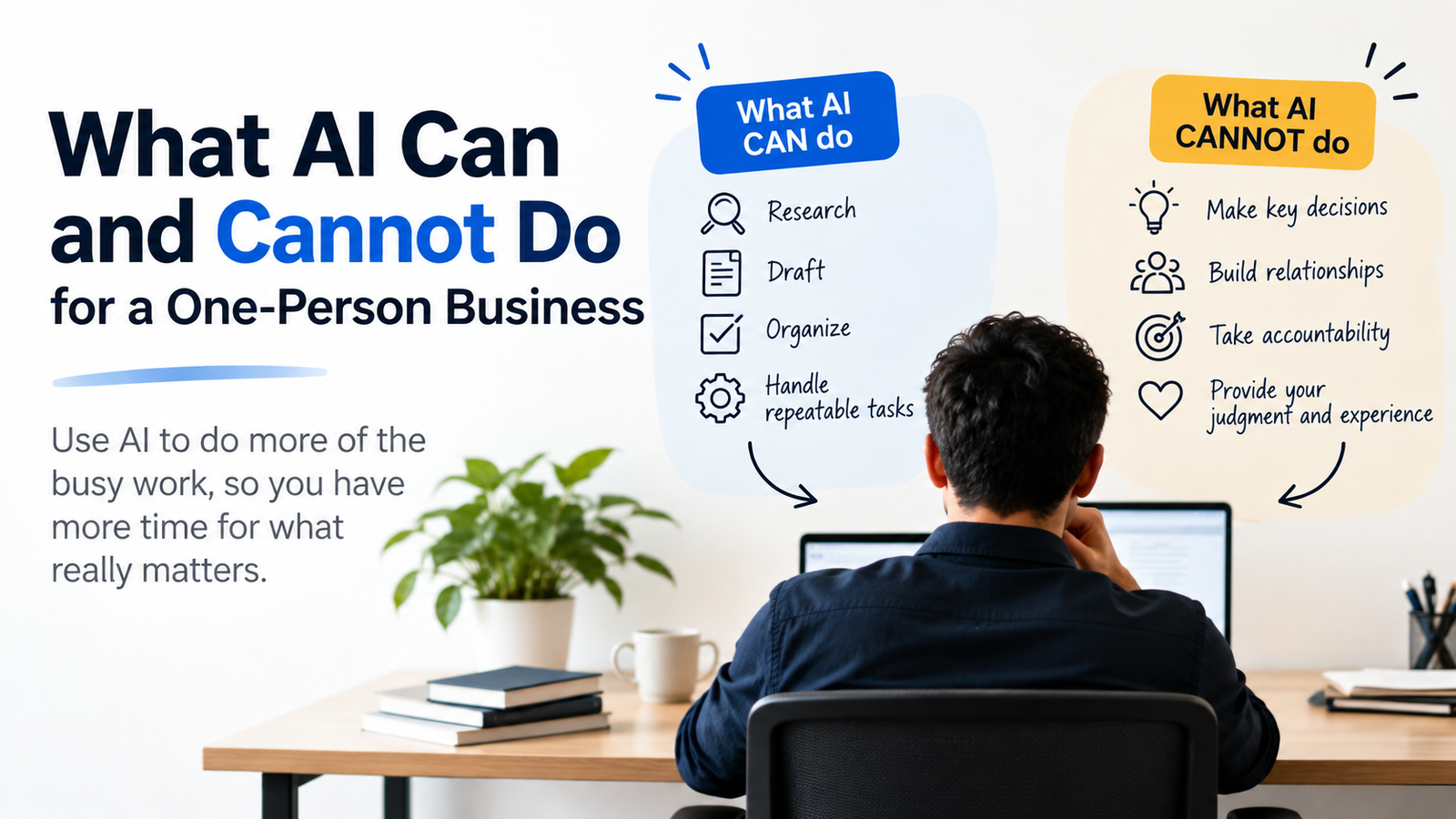
It can help you research faster, get past the blank page, organize information, summarize material, and create repeatable workflows.

You remain the person making the important decisions.

A simple principle to remember is:

AI can prepare. You approve.

That distinction becomes especially important when customers, money, reputation, or important business decisions are involved.

Where AI Can Save a Solo Business Owner Time

Imagine a typical Monday.

You have a customer call at 10 AM.

A proposal needs to go out before lunch.

You have several follow-up emails waiting.

You need to publish something for your business.

There’s also a pile of notes from last week that you haven’t organized yet.

Without assistance, every one of those tasks starts with you.

That’s where AI can reduce some of the workload.

1. Research

Research can quietly consume hours.

You might need to understand a new market, investigate a topic, compare approaches, prepare for a customer conversation, or collect information before making a decision.

AI can help you:

  • Generate research questions

  • Organize information into themes

  • Summarize lengthy material

  • Compare different options

  • Turn research into a structured brief

The important distinction is that AI can help you process information.

It shouldn’t automatically decide what that information means for your business.

For important decisions, verify the underlying facts and apply your own experience.

2. First Drafts

The blank page is expensive for a one-person business.

Every email, proposal, article, social post, customer update, or document takes time to start.

AI can reduce that starting friction.

Give it your notes, context, audience, objective, and important points, and use the result as a first draft.

You then edit it based on your expertise.

For example, instead of spending 45 minutes trying to write the perfect follow-up email from scratch, you might spend a few minutes giving AI the context and another few minutes improving the draft.

The goal isn’t to publish whatever AI produces.

The goal is to stop starting everything from zero.

3. Organization

Solo business owners accumulate information everywhere.

Meeting notes.

Voice notes.

Ideas.

Customer requests.

Research.

To-do lists.

Documents.

AI can help turn that mess into something usable.

You can use it to turn meeting notes into action items, group ideas into categories, structure rough notes, create checklists, or convert an informal process into documented steps.

That might sound like a small improvement.

But when you’re the only person running the business, reducing mental clutter can be just as valuable as completing a task faster.

4. Repeatable Workflows

This is where AI can become particularly useful.

Look at the tasks you repeat every week.

Maybe every customer meeting requires you to organize notes and create follow-up actions.

Maybe every new inquiry requires a similar response.

Maybe every piece of content starts with the same research and outlining process.

Instead of approaching those activities as completely new tasks each time, build a repeatable workflow around them.

For example:

Meeting → Notes → AI-assisted summary → Action items → Your review → Final task list

Or:

Idea → AI-assisted outline → First draft → Your experience and opinion → Final content

Or:

Customer question → Response draft → Your fact and tone check → Send

The individual AI interaction matters less than the workflow surrounding it.

A reliable process can save you time repeatedly.

What AI Should NOT Do for Your Business

Saving time is useful.

Giving up control isn’t.

There are parts of your business where efficiency should not be the primary goal.

AI Shouldn’t Make Your Key Business Decisions

AI can help you explore options.

It can identify considerations you may have missed.

It can organize the information behind a decision.

But deciding what to charge, which customers to work with, which direction to take the business, or what promise to make should remain your responsibility.

Use AI to improve the information available to you—not to outsource accountability.

AI Shouldn’t Own Customer Relationships

A customer relationship contains context that may never appear in a prompt.

You know what happened during the previous project.

You know why a customer is frustrated.

You understand which promises you’ve made.

AI doesn’t automatically have that context.

It can help you prepare communications, but important conversations still need your judgment.

AI Shouldn’t Be Trusted Without Review

AI-generated information can be incorrect, incomplete, outdated, or inappropriate for your particular situation.

That means there should be a review step before AI-generated work leaves your business.

Check facts.

Check names, numbers, and dates.

Check customer-specific information.

Check promises and commitments.

And ask one important question:

Would I be comfortable taking responsibility for this if my name were attached to it?

If the answer is no, it isn’t ready.

A Simple Test: What Should You Give AI?

If you’re unsure where to start, look at your weekly tasks and ask three questions:

Is this repetitive?

If you perform essentially the same task repeatedly, there may be an opportunity to create an AI-assisted process.

Does this require significant judgment?

The less judgment a task requires, the easier it usually is to delegate parts of it.

Can I easily review the output?

AI is most useful when you can quickly tell whether the result is good or bad.

That gives you a useful rule:

Low risk + repetitive + easy to review = a good AI candidate.

On the other hand:

High stakes + difficult to verify + significant accountability = keep strong human control.

Start With One Workflow, Not 20 AI Tools

A common mistake is trying to “AI-enable” the entire business at once.

You subscribe to several tools.

Build complicated automations.

Save dozens of prompts.

And suddenly, managing your AI setup becomes another job.

Start smaller.

Identify one repetitive task that regularly consumes your time.

Maybe it’s turning meeting notes into follow-up actions.

Maybe it’s preparing a weekly customer update.

Maybe it’s converting your ideas into first drafts.

Maybe it’s organizing research.

Create one simple AI-assisted workflow for that task.

Use it for a week.

Notice where the output fails.

Improve your instructions and review process.

Then ask yourself:

Did this actually save me time without reducing quality?

If it did, keep it.

Then move to the next task.

The Real Advantage of AI for a One-Person Business

The biggest opportunity isn’t pretending you have a team of 20 people.

It’s protecting more of your limited time.

As a one-person business owner, your judgment is one of your most valuable resources.

Your customers hire you because of what you know, how you think, what you create, or the service you personally provide.

Every hour spent unnecessarily formatting information, organizing notes, creating routine first drafts, or repeating administrative processes is an hour you can’t spend applying that judgment.

So don’t ask:

“How much of my business can AI run?”

Ask:

“Which parts of my work don’t need to start and end with me?”

Use AI for research.

Use it for drafting.

Use it for organization.

Use it for repeatable workflows.

But keep strategy, relationships, judgment, accountability, and important decisions human.

You may be running a one-person business.

That doesn’t mean every task needs to be done manually by one person.


Ready to Put This Into Practice?

Knowing where AI can help is one thing.

Identifying the right tasks in your business is the next step.

Get the Solo-Business AI Starter Checklist to identify repetitive tasks, decide what to delegate to AI, keep the right work under human control, and build your first practical AI-assisted workflow.

KEEP THE IDEAS MOVING

Let’s keep the conversation going

Start with a useful story, a page that needs focus, or a campaign you want to understand better. New notes will keep appearing on the blog.

Read the latest ideas ↗

GET IN TOUCH

Have an idea? Let’s talk.

Thoughtful marketing, good ideas, and useful collaborations are always welcome.

FIND ME ELSEWHERE

◎

Instagram

𝕏

X

Better digital marketing, delivered.

Fresh ideas on SEO, content and digital marketing—plus every new post, straight to your inbox.

We don’t spam! Read our privacy policy for more info.