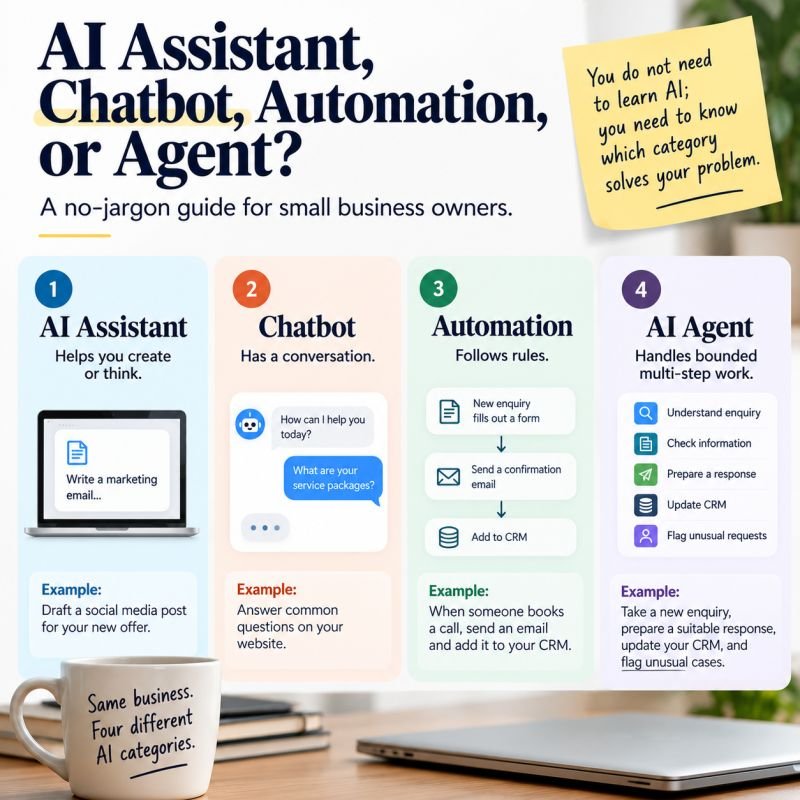
AI assistant. Chatbot. Automation. AI agent.
If those terms are starting to sound like four different ways of saying the same thing, you’re not alone.
The good news is that you don’t need to become an AI expert to use AI in your business.
You only need to understand one practical difference:
What kind of job can each category do for you?
For a small business owner, that’s far more useful than knowing how the technology works behind the scenes.
Here’s the simplest way to think about AI terminology for small business:
Assistants help you create.
Chatbots help you converse.
Automations follow predefined rules.
Agents handle bounded, multi-step work toward a goal.
Once you understand those four categories, choosing where AI fits into your business becomes much easier.
Why AI Terminology Gets Confusing So Quickly
Imagine you want to reduce the time your business spends answering customer enquiries.
You start researching.
One company tells you that you need an AI assistant.
Another recommends an AI chatbot.
Another talks about AI automation.
Then someone tells you AI agents are the future.
Twenty minutes later, you’re comparing software instead of solving the original problem.
This is where small business owners can get stuck.
Instead of starting with terminology, start with the job.
Do you need something to draft?
Do you need something to have a conversation?
Do you need something to automatically perform a predictable action?
Or do you need something to complete several connected steps within clear boundaries?
Those questions make the categories much easier to understand.
1. AI Assistants: When You Need Help Creating or Thinking
An AI assistant is probably the easiest category to understand because many small business owners have already encountered one.
You give it instructions or information.
It helps produce an output.
For example, imagine you run a small cleaning company.
You receive this customer message:
“I need a quote for cleaning a three-bedroom house every fortnight. Can you tell me what information you need?”
Instead of writing a reply from scratch, you could ask an AI assistant to draft a friendly response requesting the relevant details.
You review it.
You change anything that doesn’t sound like you.
Then you send it.
The important part is that the assistant is helping you do the work, rather than independently running the entire process.
AI assistants can be useful for tasks such as drafting emails, rewriting documents, summarising information, brainstorming marketing ideas, preparing first drafts of social posts or turning rough notes into something more organised.
Think:
“Help me create this.”
That’s assistant territory.
2. AI Chatbots: When You Need Something to Converse
A chatbot has a different job.
Its main purpose is interacting through conversation.
You’ve probably encountered basic chatbots on websites already.
A potential customer arrives on your website at 9:30 p.m. and asks:
“Do you deliver outside the city?”
The chatbot can respond using the information it has been given.
The customer then asks:
“How much does delivery cost?”
The conversation continues.
That’s different from sitting down with an AI assistant and asking it to help you write tomorrow’s marketing email.
For a small business, a chatbot can make sense when you repeatedly receive similar questions and customers benefit from getting answers without waiting for you to become available.
Think:
“Talk with this person.”
That’s chatbot territory.
There’s an important limitation, though.
A chatbot is only useful when it has reliable information and clear boundaries.
If your prices, policies or availability change frequently, you need to make sure the system isn’t confidently giving customers outdated information.
3. Automations: When the Rule Is Already Clear
Automation doesn’t necessarily mean a robot making decisions.
Often, it’s much simpler.
An automation basically says:
When X happens, do Y.
Imagine you run a photography business.
Someone completes the enquiry form on your website.
Your process might be:
When a new enquiry arrives → send a confirmation email → create a lead in your system → notify the person responsible for responding.
The steps are already known.
The system doesn’t need to decide what your business should do next. You’re giving it the rule in advance.
Another example could be:
When an invoice becomes overdue → send a reminder.
Or:
When someone books an appointment → send confirmation instructions.
This is why automation is often valuable for repetitive administrative work.
Think:
“When this happens, always do that.”
That’s automation territory.
And there’s an important distinction here.
Not every useful automation needs AI.
If a simple rule can reliably solve the problem, a straightforward automation may be all you need.
Don’t add AI just to make a process sound more advanced.
4. AI Agents: When the Job Requires Several Steps
This is the term you’re likely to hear increasingly often.
An AI agent goes beyond producing a single answer or following one fixed rule. It can work through multiple steps toward a defined goal, using the tools and permissions available to it.
The important word for a small business is bounded.
You don’t want to think:
“Give AI control of my business.”
Think:
“Handle this specific process within these limits.”
For example, imagine you receive enquiries from potential customers.
A bounded agent might be set up to review an enquiry, identify what service the customer is asking about, check whether required information is missing, prepare an appropriate response and update the enquiry’s status.
That’s not one task.
It’s several connected tasks working toward one defined outcome.
But there should still be boundaries.
Perhaps the agent can prepare a quote but cannot send it without approval.
Perhaps it can organise enquiries but cannot delete customer records.
Perhaps it can suggest an appointment but cannot confirm anything above a certain value without a person checking.
Think:
“Complete these connected steps toward this specific goal.”
That’s agent territory.
The Difference in One Everyday Example
Suppose you own a small plumbing business and want to improve how you handle new enquiries.
An AI assistant could draft a response to a customer’s email.
A chatbot could answer common questions while a customer is on your website.
An automation could send a confirmation whenever somebody submits your enquiry form.
An AI agent could work through several steps, such as reviewing the enquiry, identifying the type of job, checking for missing details, preparing a response and updating the lead in your system.
Same business.
Same general area of work.
Four different categories.
That’s why understanding the problem matters more than memorising AI terminology.
So Which Type of AI Does Your Small Business Need?
Don’t start by asking:
“Should we get an AI agent?”
Start with:
“What exactly are we trying to improve?”
Then look at the nature of the task.
| If you need to… | Start by exploring… |
|---|---|
| Draft, summarise or create something | AI assistant |
| Hold conversations and answer questions | Chatbot |
| Trigger predictable actions based on rules | Automation |
| Complete bounded, multi-step work | AI agent |
You may eventually use all four.
You may only need one.
And you may discover that some problems don’t require AI at all.
That’s perfectly fine.
Technology should earn its place in your business by solving a real problem.
Don’t Buy the Category Before You Understand the Job
This is the mistake worth avoiding.
A business owner hears that “AI agents are the next big thing” and immediately starts looking for an AI agent.
But their actual problem is that writing five customer follow-up emails every afternoon takes too long.
They might not need an agent.
An assistant could be enough.
Another business might buy an AI chatbot when its real problem isn’t customer conversations at all. It’s manually moving information between systems.
That’s closer to an automation problem.
The more clearly you define the job, the less confusing AI becomes.
A Simple Exercise Before You Look at Another AI Tool
Write down three tasks that regularly consume your time.
For each one, finish this sentence:
“I need technology to…”
Your answers might look like this:
“I need technology to help me draft customer follow-ups.”
“I need technology to answer common customer questions.”
“I need technology to automatically send information after someone books.”
“I need technology to work through several steps when a new enquiry arrives.”
Now the terminology has a purpose.
You’re not learning definitions for the sake of learning AI.
You’re identifying the category most likely to solve your problem.
You Don’t Need to Learn AI. You Need to Describe the Job.
AI terminology will continue changing.
New products will appear.
Existing tools will add new capabilities.
And marketing departments will probably invent even more terms.
You don’t need to keep up with all of them.
For most small businesses, remembering these four distinctions is enough to make much better starting decisions:
Assistants draft.
Chatbots converse.
Automations follow rules.
Agents handle bounded, multi-step work.
So before you spend another hour comparing AI products, write down the business problem you want solved.
Then ask which of those four jobs it actually requires.
Pick one repetitive problem in your business today and describe what you want technology to do in one sentence. Once you can describe the job clearly, choosing the right AI category becomes much easier.