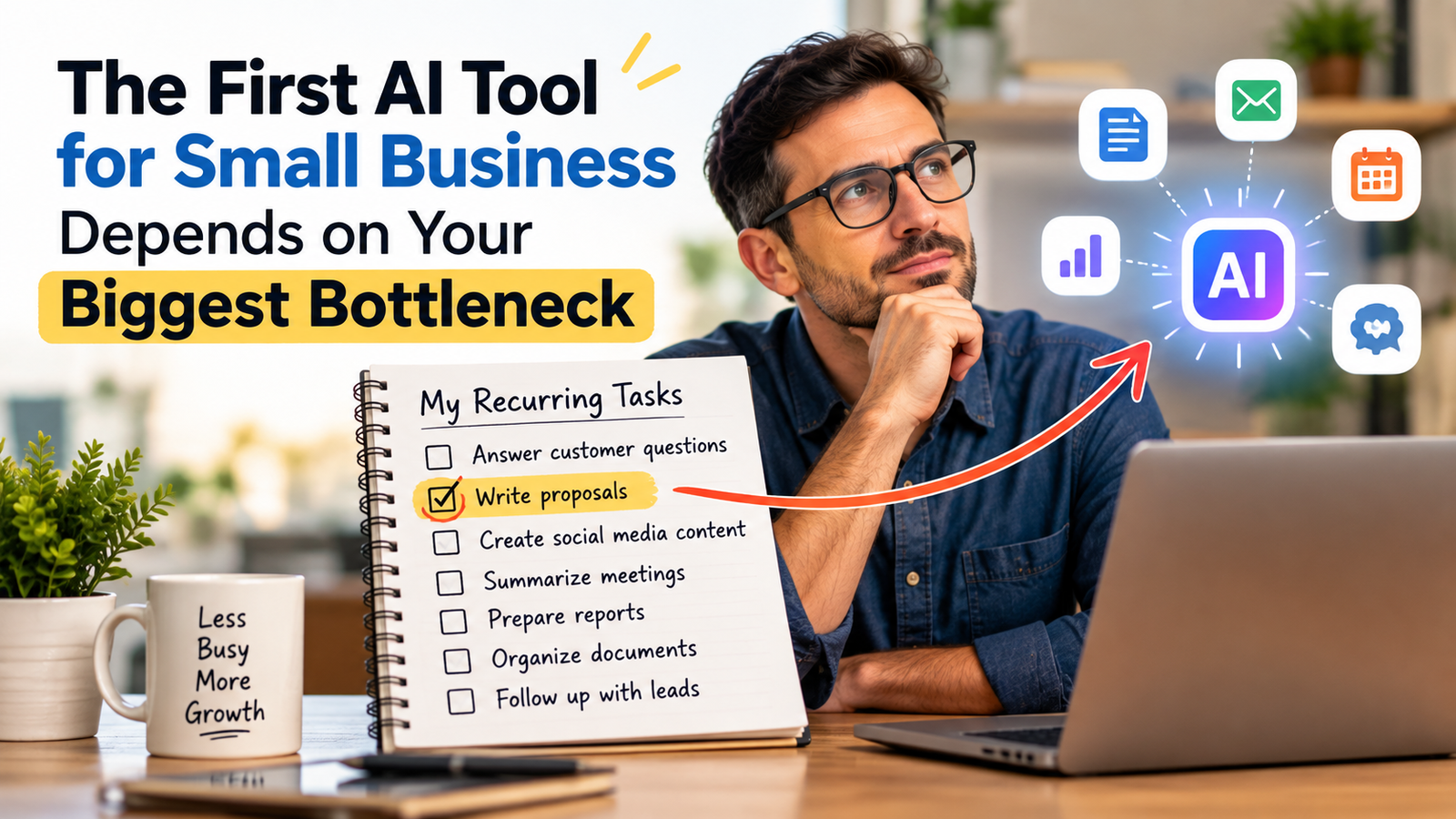
If you run a small business, you probably don’t need the AI tool everyone is talking about.
You need the one that removes a problem you deal with every week.
That might be writing customer emails.
It might be turning enquiries into quotes.
It might be keeping up with social media.
Or it could be answering the same customer questions for the hundredth time.
This is where many small business owners get AI wrong.
They hear about a popular tool, sign up, spend an afternoon trying it, and then wonder:
“What am I actually supposed to use this for?”
The better question comes before choosing the software:
What task in my business is taking too much time, happening too often, and safe enough to get AI involved?
That question will usually point you toward the right first AI tool for your small business.
You Don’t Have an AI Problem. You Have a Bottleneck Problem.
Imagine two small business owners.
One runs a local plumbing company. Every evening, they lose time replying to enquiries, writing estimates and following up with potential customers.
The other runs a small online shop. Their inbox is manageable, but creating product descriptions, promotional emails and social posts constantly gets pushed to the bottom of the list.
Should these two businesses buy the same AI tool?
Probably not.
Their businesses have different bottlenecks.
For the plumber, an AI-assisted communication or admin tool might make the biggest difference.
For the online retailer, an AI writing or marketing tool might be more useful.
This is why starting with lists like “10 AI tools every small business needs” can send you in the wrong direction.
The tool should follow the problem.
Not the other way around.
Find the Task That Keeps Getting in Your Way
You don’t need an AI strategy document to get started.
For the next few working days, pay attention to the tasks that make you think:
“I can’t believe I’m doing this again.”
Those are worth investigating.
Maybe every Monday morning you spend two hours turning rough notes into customer updates.
Maybe you repeatedly answer questions about opening hours, delivery, pricing or appointments.
Maybe every new enquiry means manually copying information from an email into another system.
Maybe you have plenty of ideas for marketing but struggle to turn them into usable content.
Write these tasks down.
You’re not looking for every possible place AI could help. You’re looking for one good starting point.
Use Three Filters Before You Choose an AI Tool
A good first task for AI usually has three qualities.
1. It happens frequently
Automating or speeding up something you do twice a year probably won’t change your business very much.
Saving ten minutes on something you do 20 times a week might.
Frequency matters because small savings add up.
If responding to routine enquiries takes five hours every week, even reducing that workload by a third could give you meaningful time back.
2. It is genuinely painful
Don’t automate a task just because you can.
Look for work that creates a real bottleneck.
Perhaps it delays customers.
Perhaps it keeps you working after hours.
Perhaps only one employee knows how to do it, so everything waits for them.
Perhaps it’s so repetitive that it regularly gets postponed.
The more friction a task creates, the more valuable it can be to improve.
3. It is relatively low-risk
This part is easy to overlook.
Your first experiment with AI shouldn’t be the task where a mistake could seriously harm your customer, finances or business.
For example, using AI to create a first draft of a promotional email is relatively easy to review before sending.
Letting AI independently make an important financial, legal, hiring or safety decision is very different.
Start somewhere you can check the output.
Think of AI as an assistant producing work for your approval, rather than an employee you’re leaving alone on their first day.
What This Looks Like in a Real Small Business
Suppose you own a landscaping company.
During a normal week, you might:
answer new enquiries;
arrange appointments;
prepare estimates;
write follow-up messages;
post before-and-after photos on social media;
order materials;
send invoices.
AI could potentially help with several of these.
But you don’t need to tackle all of them.
You notice that customer follow-ups are the biggest headache. Every quote needs a follow-up, but when you’re busy on jobs, those messages don’t get sent consistently.
That’s your bottleneck.
So instead of searching for the “best AI software for landscapers,” you could look for a tool or feature that helps draft and organise customer follow-ups.
Start there.
Test it.
See whether it saves time without reducing the quality of your customer communication.
Only then move to the next bottleneck.
Your First AI Tool Might Already Be in Software You Use
Before buying another subscription, check your existing software.
Many business tools now include AI features for writing, summarising, customer service, meeting notes, data analysis and other everyday tasks.
You may discover that the problem you’re trying to solve can be addressed without adding another platform to your business.
This also makes adoption easier.
Your team doesn’t have to learn an entirely new system just to experiment with AI.
The goal isn’t to collect AI tools.
The goal is to remove friction.
Don’t Ask “Which AI Tool Should I Buy?”
Ask:
“Which task should I improve first?”
Then evaluate tools based on that task.
For example, if your biggest bottleneck is replying to repetitive customer questions, look at AI-assisted customer support.
If it’s creating first drafts of emails and marketing copy, look at writing assistance.
If meetings leave you with pages of notes and forgotten actions, look at AI meeting summaries and task extraction.
If you’re constantly digging through spreadsheets for simple answers, look at AI-assisted data analysis.
Different problem. Different starting point.
That is exactly how it should be.
Run a Small Test Before Changing Your Business
Once you’ve identified a task, don’t immediately automate the entire process.
Run a small experiment.
Take 10 examples of the task you’ve already completed yourself. Try using your chosen AI tool on similar examples and compare the results.
Ask yourself:
Did it actually save time?
How much editing did the output require?
Would I trust an employee to use this with a simple review process?
Did it make the task easier, or did it just add another piece of software to manage?
If the tool saves five minutes but requires ten minutes of checking and fixing, you haven’t solved your bottleneck.
You’ve created a new one.
A Simple Way to Choose Your First AI Task
If you’re still unsure where to begin, take a piece of paper and make three columns:
Task | How often? | How painful?
List the repetitive work you did over the last week.
Then circle the tasks that happen frequently and cause the most frustration.
From those, remove anything where an AI mistake would create unacceptable risk.
What’s left is your shortlist.
Pick one.
That’s a much better starting point than downloading whatever AI tool happens to be trending this week.
Start With One Bottleneck, Not an AI Transformation
Small businesses don’t need to become “AI-powered” overnight.
You don’t need ten subscriptions.
You don’t need to understand every new AI model.
And you certainly don’t need to change your entire business because somebody says AI is changing everything.
Find one repetitive, painful, low-risk task.
Choose a tool that can help with that specific job.
Keep a human checking the work.
Measure whether it genuinely saves time or improves the process.
Then decide whether AI deserves another job in your business.
Not sure what your first AI tool for small business should be? Start by writing down the three tasks you most wish you could stop doing manually. Your best first use of AI is probably hiding somewhere on that list.